Fork light barriers
Frame light barriers from Dietz work like through-beam light barriers. Transmitter, receiver and electronics are combined in a single sturdy metal housing.
The easy installation without time-consuming alignment, short response times and a high resolution are crucial advantages compared to conventional through-beam light barriers, make possible in practice the exact positioning and a reliable detection of even the fastest movement sequences.
The sensors have a sensitivity adjustment and mostly can be toggled between normally open and closed. Clocked red or infrared light guarantees a high ambient light immunity.
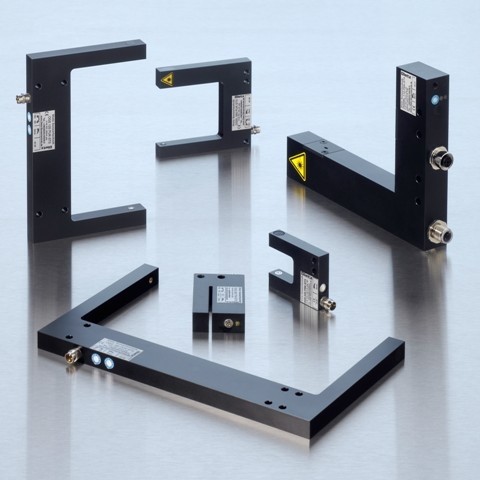
Find more versions in our product finder
Typical application ranges of frame light barriers
Frame light barriers: application examples
- Mounting and feeding automisation
- Packaging machines and special machinery construction
- Production lines
- Detection and counting of objects
- Positioning and presence control
- Ejection control
- Detection of thinnest foils and wires
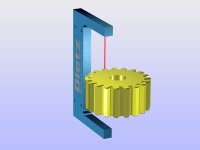
- Rotary speed measurement
- Edge guide control
- Double sheet detector
FAQ
What is a fork light barrier?
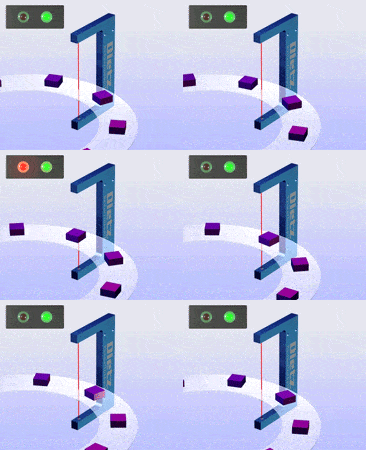
The core component of the fork-type optical sensor is a one-way optical sensor . It works as follows: An optical transmitter emits a beam of light. On the opposite side, an optical receiver receives this beam. This makes the receiver conductive, and current flows.
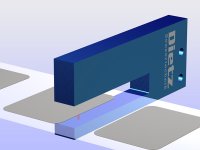
Light forms an optical boundary. When an object enters the light beam and breaks through it, no current flows. The light barrier then triggers an electrical signal. A fork-type light barrier has two arms, at the ends of which a receiver and a transmitter are attached. The light beam passes between them.
How do fork light barriers work in practice?
Eine Gabellichtschranke kann zum Beispiel an einem Zuführband in der Fabrik montiert werden. Dann können mithilfe der Lichtschranke Teile erfasst werden, die auf diesem Band liegen und davon durch den Lichtstrahl bewegt werden. Eine Gabelleichtschranke kann auch im Innern einer Maschine verbaut sein, etwa an einem Zahnrad. Dort kann sie die Drehzahl des Zahnrades messen. Auch Positionen von Geräten oder Werkstücken lassen sich mit einer Gabellichtschranke bestimmen. Die mit einer Gabel-Lichtschranke erfassten Messwerte lassen sich auf verschiedene Weise auswerten.
In der Industrie gewinnt die Automation von Produktionsabläufen immer größere Bedeutung. Deshalb werden in immer mehr Bereichen spezialisierte Sensoren benötigt.