

Capacitive Sensors
Capacitive proximity switches are touchless and contactless limit switches, and therefore wear-free. They are used to detect both metallic and non-metallic materials, whether solid or liquid.
The active area of the capacitive sensor consists of two metallic electrodes. It is activated by an object approaching the sensor’s active area, thus entering the electric field of the electrodes. This increases the coupling capacitance, causing the oscillator to oscillate. An evaluation unit measures the oscillation amplitude and converts it into a signal.
Capacitive sensors are activated by conductive and non-conductive materials. Larger switching distances are achieved with metallic objects due to their high conductivity. When detecting organic materials, such as grain or wood, the switching distance is strongly dependent on their moisture content.
Further details can be found in the product finder.
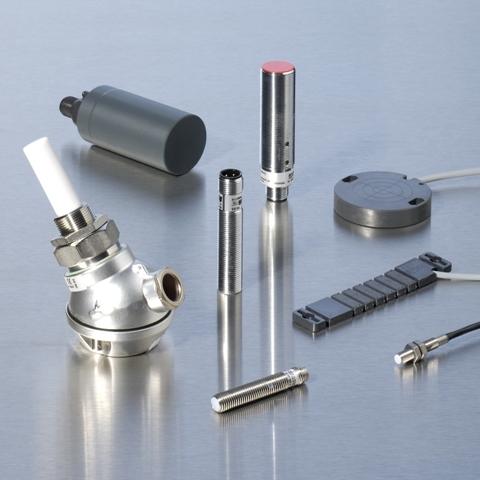
Dietz capacitive proximity switches are available in a wide variety of designs and materials, with switching distances up to 120 mm, in DC and AC versions, and with switching or analog outputs. They cover a broad range of automation tasks wherever a production-related parameter (distance or fill level) needs to be monitored.
Product range
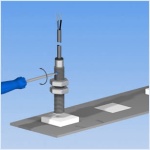
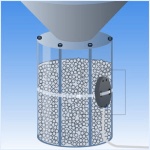
Application examples
- Cylindrical from Ø 2 mm
- Disc and miniature designs
- switching and analog outputs
- DC and AC voltage
- high temperature sensor/low temperature sensor
- Teflon housing (food safe)
- Leak detectors, rod probes
More information Capacitive sensors
Capacitive sensors play just as important a role in the functional monitoring of machines and systems as in the control of manufacturing processes and position monitoring of moving parts. A large selection of powerful and high-resistance capacitive sensors can be found in the Dietz Sensortechnik range. Call us now and find exactly the right model for your application.
How capacitive sensors work
Capacitive sensors are non-contact switches or measuring devices that detect conductive and non-conductive materials such as metals, wood, plastics, liquids, pastes and bulk goods. Even measurements by non-conductive materials can be realized.
One of the most important technical basics is the integrated high-frequency oscillating circuit, which creates an oscillating electric field on the active sensor surface. As solid or liquid substances approach this area, the capacitance of the integrated capacitor changes. This in turn leads to a reinforcement of the oscillating circuit. If a certain threshold value is exceeded, a switching signal is triggered.
Advantages of capacitive sensors
Capacitive sensors have a number of advantages with which they are suitable for many areas of application. First of all, here is their ability to capture materials even through walls. In addition, the following aspects are particularly relevant.
- Cheap production
- Small size and light weight
- high sensitivity
- pronounced energy efficiency
- long lifespan
The right capacitive sensor for every application
Capacitive sensors from Dietz Sensortechnik are used in a wide variety of areas. You too can benefit from our years of experience and find exactly the right model for your needs.
Pressure sensors:
With capacitive pressure sensors, the pressure on a condenser plate acting as a condenser plate causes the capacitor’s capacitance to change. This change is converted into a signal and further processed or evaluated. Since it is very low, particularly sensitive processing technology is required.
Distance Sensors:
With the capacitive distance sensor or proximity switch, the fact that the capacitance of a capacitor increases with a drop in the distance increases. In this case, the plates consist of the capacitive distance sensor and the movable counter surface. Distance sensors are used, for example, in the monitoring of rope layers in cable cars, for gap sensors and for scanning tunneling microscopes.
Other areas of application:
- Proximity switch
- level sensor
- acceleration sensor
- path sensor
- angle sensor
What to look for when choosing capacitive sensors
Capacitive sensors are available in a wide variety of designs, which is why a few things should be considered when choosing.
The switching distance:
The switching distance has a significant influence on the areas of application in which a capacitive sensor can be used. It is defined as the distance between the area of the sensor and the monitored object. With the capacitive sensor, the switching distance depends on the sensor surface and the dielectric constant of the respective material. Since the dielectric constant of water is high, the moisture content of the medium has a correspondingly large influence.
To ensure that the sensors work correctly and do not influence each other, certain distances must be observed. When installed on the side, the distance is at least twice the sensor diameter. On the safe side you are at intervals of an order of eight times the sensor diameter. For opposite sensors, the minimum distance should be eight times the nominal switching distance.
The housing:
The housing depends on the areas in which the sensor can be used. Robust material combinations such as stainless steel and PTFE are particularly necessary in areas with extreme climates. They can withstand temperatures of up to 125 °C and also resist chemicals. In this context, it is also important to pay attention to the degree of protection, which indicates how well the sensor is protected against splash water and penetrating foreign bodies. For example, sensors with protection class IP68/69 are suitable for cleaning with high-pressure devices.
The precision:
Capacitive sensors have an accuracy of approx. 3%. High-precision reference sensors have up to 1%. In this context, long-term stability must also be taken into account. It indicates by what percentage the accuracy decreases per year.
Feel free to call us
The variety of different sensor types makes it clear that there can be no universal model that covers all applications. There are individual requirements in each area. To find the right model for your area of application, contact Dietz Sensortechnik now. We would be happy to advise you comprehensively and find the right sensors for you.
FAQ
Where are capacitive sensors and proximity switches used?
Capacitive sensors always offer very high accuracy and also universal functionality. Due to these properties, capacitive proximity switches are used in almost all branches of industry. They fulfill a wide variety of tasks in very different production areas. These include, for example, thickness measurement or position measurement, as well as checking levels.
How does a capacitive sensor actually work?
The principle of operation of a capacitive sensor is that of an open capacitor. An electric field is constructed between electrodes. If a material then enters the electric field that has a higher dielectric number than the air, the capacity of the field increases. The precision electronics measures this increase in capacity. A signal is generated and precisely evaluated in the course of signal processing. This process then leads to the switching of the output.
How are conductive materials detected?
Leitende Materialien haben normalerweise eine elektrische Leitfähigkeit von mehr als 20 µS / cm. Deshalb können sie von allen kapazitiven Näherungsschaltern sehr gut erkannt werden. Das heißt, dass die Dielektrizitätszahl (siehe unten) keine Rolle für den Schaltabstand spielt. Der Schaltabstand hängt von der Größe des Objektes und dessen Erdung ab.
What is different with non-conductive materials?
Non-conductive materials usually have an electrical conductivity of less than 20 µs/cm. When a non-conductive object is placed in the field of a sensor, the field intensifies. This gain depends on the dielectric number and the size of the material to be detected. The deeper the electrical conductivity, the more difficult it is to actually detect the medium.
What does the dielectric number indicate?
Capacitive sensors can detect conductive and non-conductive media with a dielectric number greater than one. This dielectric number is sometimes also referred to as dielectric conductivity or permittivity. Its value indicates how many times the electric flux density becomes larger when the corresponding material penetrates the measuring field.
Which designs are generally available?
Capacitive sensors are available in round or cuboid shape. The dimensions range from a few millimeters to over ten centimeters in length. When it comes to the selection, the planned assembly is of crucial importance, as is the use. For example, round sensors can be fixed with a special sensor holder. Other models can also be glued. Some sensors are designed for use as start or stop buttons that are triggered by hand movement. They can then be assigned to their meaning, for example, by means of symbols.
What materials are used for the housing?
Basically, the housings for capacitive sensors are available in the same materials as those of the inductive sensors: housings made of brass and plastic are used, for example, in the field of mechanical engineering. Stainless steel is primarily used as a material in the food industry and in the chemical industry. This also applies to Teflon, whereby the latter is particularly in demand where a great resistance to acids, lye, aggressive oils and the like is necessary.
Is the switching distance continuously adjustable?
yes You can use the potentiometer to continuously adjust the switching distance. It does not take into account any deviations due to external conditions such as temperature, voltage or humidity. Manufacturing tolerances are also irrelevant.
What connections are there?
Basically, you have the choice between plug-in connections and devices with cables. The plug-in connectors are usually three-, four- or six-pole standard connectors.
Which outputs are used?
In general, the standards PNP and NPN are used. PNP is common in European countries, while NPN is in Asia. The difference between the two is that the switching wire in PNP circuits is “plus”, but with NPN “zero”.
What types of installation are there?
There are flush and non-flush switches. The former close flat with the surrounding surface. But not flush-mounted need a free space on the side of the active surface in order to be able to function without interference.